

The November 13, 2026 FAA ground stop grounded every departing flight in the United States for more than four hours after a telecom failure hit 22 air traffic control centers. It wasn’t a hack, officials say, just old equipment overloaded with data. The real lesson for your household isn’t about flying. It’s that if the most watched system in the country can go dark without warning, your power, water, phone and payment systems can too, and you need a plan that doesn’t depend on any of them working.
Key Takeaways
- The FAA ground stop on November 13, 2026 was caused by a telecommunications overload, not a cyberattack, according to federal officials.
- It was only the second nationwide ground stop since 9/11; the other was the 2023 NOTAM system failure.
- Outages don’t need a villain. Aging infrastructure, software bugs, and weather cause most disruptions.
- AI tools are lowering the skill barrier for attacks on infrastructure like water utilities, according to 2026 research from Dragos.
- Modern emergency planning has moved past the old “72-hour” rule toward multi-week resilience goals.
- Cash, paper records, and backup power are now treated as core household essentials, not optional extras.
- Scams spike hard during any major outage. Never act on an incoming call, text, or email without verifying it yourself.
- Build layered kits: one at home, one in a go-bag, one in your vehicle.
What Is an FAA Ground Stop and How Does It Work?
An FAA ground stop is an order that halts departures, either at one airport, a region, or the entire country, to protect safety when air traffic control can’t reliably track planes. The FAA’s command center issues it, and no flights can leave the ground until it’s lifted.
Think of it as the system’s emergency brake. When controllers lose radar feeds, radio frequencies, or coordination between facilities, letting planes keep taking off would be dangerous. Stopping new departures gives the system time to stabilize while planes already in the air land safely.
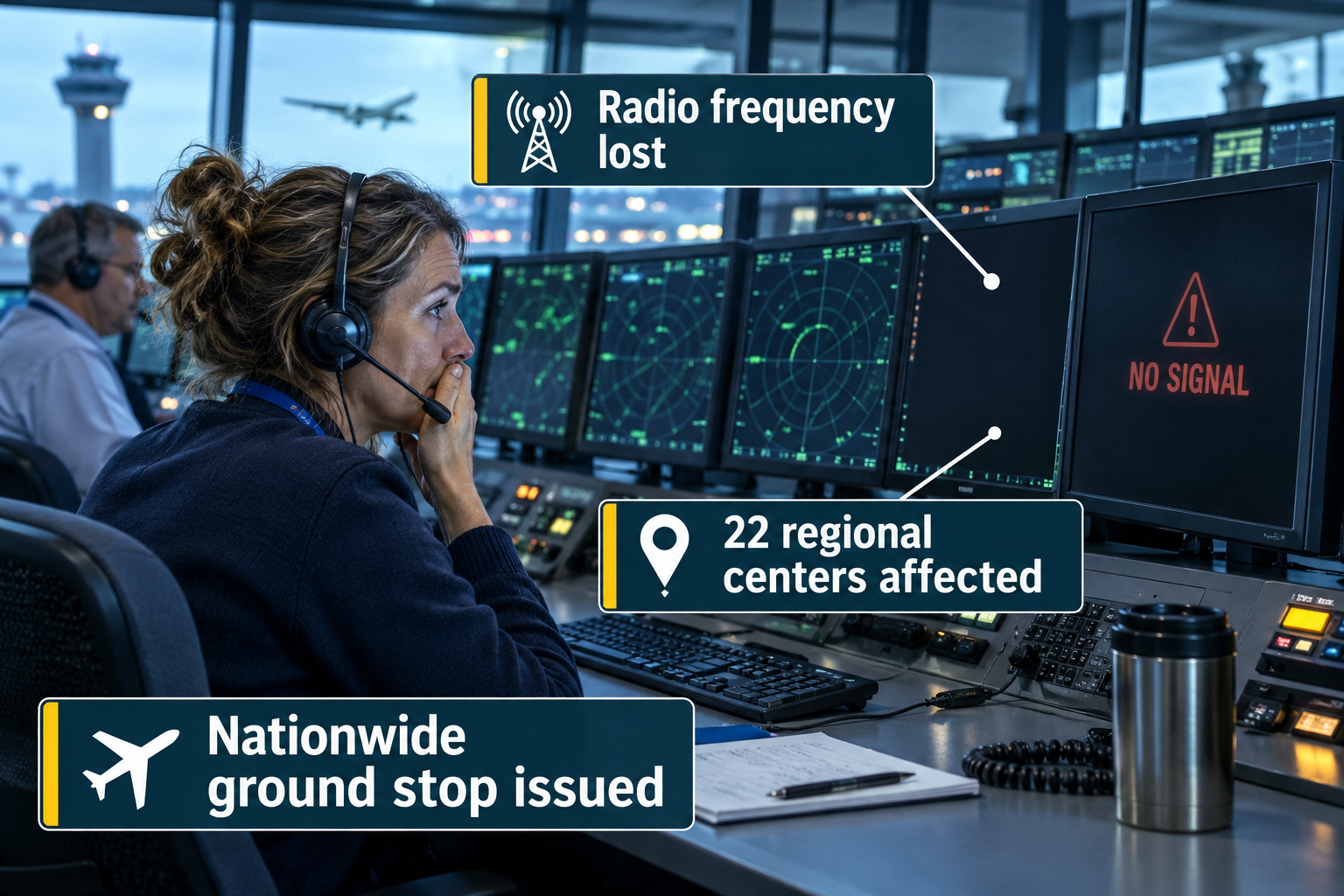
A ground stop is different from a slowdown or a delay program. Those just space flights out. A full ground stop, especially a nationwide one, stops the pipeline entirely. On November 13, 2026, that’s exactly what happened: at 3:54 p.m. Eastern, a telecom failure cascaded through all 22 regional air route traffic control centers, and the FAA issued a stop covering every departing flight in the country.
What Causes the FAA to Issue a Ground Stop?
Ground stops happen when controllers lose the tools they need to safely separate aircraft, which can come from technology failures, severe weather, staffing shortages, or security threats. The November 2026 event was attributed to aging infrastructure, not an attack.
Common triggers include:
- Equipment failures. Radar outages, radio frequency loss, or (as happened in November 2026) telecom routers getting overloaded with data from newer systems layered onto old hardware.
- Severe weather. Thunderstorms, blizzards, or hurricanes that make flying unsafe across a region.
- Software issues. The January 2023 ground stop came from an accidentally deleted file in the FAA’s NOTAM system, which warns pilots about hazards.
- Security concerns. Rare, but possible if there’s a credible threat.
Transportation Secretary Sean Duffy said the November 13 event happened because new technology added to the system overloaded older routers, causing gaps in radar and communications. Congress had already approved $12.5 billion for upgrades, and Duffy called for $50 billion more after this incident.
How Long Do FAA Ground Stops Typically Last?
Most ground stops last anywhere from a few minutes to a few hours, depending on how fast the underlying problem is fixed. The November 13, 2026 nationwide stop lasted more than four hours before being lifted.
Localized, weather-related ground stops at single airports often resolve within an hour or two once a storm passes. System-wide failures take longer because engineers have to diagnose and fix the root cause before it’s safe to resume departures everywhere at once. The 2023 NOTAM outage took most of a morning to resolve. The ripple effects, though, last much longer than the stop itself: FlightAware tracked more than 10,000 delayed flights and over 4,000 cancellations tied to the November 2026 event, stretching recovery into the following day.
Decision rule: if you’re flying and hear about a ground stop, assume delays will outlast the stop itself by at least a full day. Don’t rebook in a panic; airlines typically auto-rebook affected passengers within 24 to 48 hours.
How Do You Know if There’s Currently an FAA Ground Stop?
The fastest way to check is the FAA’s own National Airspace System Status page, which updates in real time, along with flight tracking apps like FlightAware and FlightRadar24. Airlines also push alerts directly to ticketed passengers.
Here’s where to look, in order of reliability:
- FAA.gov’s NAS Status page, the official source, updated directly by air traffic control operations.
- Your airline’s app or text alerts, if you’re ticketed, this is the fastest way to know your specific flight is affected.
- FlightAware or FlightRadar24, good for seeing the scope of a disruption in real time.
- Local news and verified social accounts, useful for context, but confirm with an official source before acting.
What Happens to Flights During an FAA Ground Stop?
During a ground stop, flights that haven’t taken off stay on the ground, while planes already in the air are told to land at the nearest suitable airport, sometimes far from their original destination. On November 13, 2026, hundreds of flights were diverted this way.
Here’s the typical sequence:
- Planes mid-flight get rerouted to land, sometimes at airports they weren’t scheduled to visit.
- Planes at the gate stay there; boarding and pushback pause.
- Connecting passengers often miss their next leg, since the ripple effect spreads across the network.
- Airlines begin mass rebooking once the stop lifts, prioritizing based on fare class and original departure time.
Common mistake: assuming your flight is cancelled the moment you hear “ground stop.” Most ground-stop flights are delayed, not cancelled. Check your airline’s app before making other plans.
Can You Still Book Flights During a Ground Stop?
Yes, airline booking systems usually stay online during a ground stop, since the stop affects departures, not ticketing or reservation systems. You can book or change flights, but new bookings won’t take off until the stop lifts.
That said, booking a brand-new flight for later the same day during an active nationwide ground stop is risky. Airlines don’t know yet how fast they’ll clear the backlog, so you might book something that gets cancelled anyway. A smarter move: wait for your airline’s official rebooking offer, which often comes with fee waivers it wouldn’t normally offer.
Does a Ground Stop Affect Other Transportation Like Trains?
No, an FAA ground stop only applies to departing flights and has no direct authority over trains, buses, or highways. Those systems run under separate agencies and rarely see effects unless the same root cause (like a regional power outage) hits them too.
That said, indirect effects are real. When a nationwide ground stop strands travelers, you’ll often see:
- Spikes in rental car demand near affected airports
- Amtrak and regional rail seeing surges in last-minute bookings
- Rideshare surge pricing near major hubs
If you’re stranded, trains and buses are usually a safe backup option since they’re not tied to FAA operations at all.
What’s the Difference Between a Ground Stop and an Airport Closure?
A ground stop pauses departures temporarily while the airport itself stays open and operational; an airport closure shuts the facility down entirely, often for longer, due to things like runway damage, extreme weather, or security incidents. Arrivals can sometimes still happen during a ground stop but never during a full closure.
FeatureGround StopAirport ClosureDurationMinutes to hoursHours to daysArrivals allowedOften yesNoScopeCan be one airport or nationwideUsually one airportTypical causeTech failure, weather, staffingPhysical damage, severe weather, securityWho issues itFAA command centerAirport authority or FAA
Choose to worry less if: your airport is under a ground stop but still shows arrivals landing. That’s a sign the facility itself is fine and this is a traffic-flow issue, not a structural one.
How Does Supply Chain Break Down During Air Travel Disruptions?
Air cargo disruptions delay anything shipped by plane, including fresh produce, medical supplies, pharmaceuticals, and e-commerce packages, usually within 24 to 72 hours of a major stoppage. The November 2026 ground stop, while brief, still backed up freight schedules at major air cargo hubs for a day or more.
Here’s where it shows up fastest:
- Pharmacies waiting on time-sensitive shipments of medications or vaccines
- Grocery stores that fly in fresh seafood, flowers, or specialty produce
- E-commerce orders marked as “next day air,” which quietly slip to two or three days
- Hospitals relying on air-shipped lab samples, organs, or specialized equipment
A single four-hour ground stop rarely breaks the supply chain on its own. The risk is compounding events: a ground stop during a winter storm that’s already slowing ground shipping, for example.
What Groceries and Supplies Should I Stockpile Before a Disruption?
Build a pantry around food your family already eats that needs no refrigeration and little or no cooking, aiming for at least two weeks rather than the old three-day minimum. Current emergency planning guidance has moved past “72 hours” toward multi-week resilience.
A practical stockpile list:
- Canned meats, beans, soups, vegetables, and fruit
- Peanut butter, nuts, granola bars, crackers
- Rice, pasta, oats, instant potatoes
- Shelf-stable milk, coffee, and tea
- One gallon of water per person per day, for drinking and sanitation, for at least a week (two weeks is better)
- A manual can opener
- Pet food and any baby formula or diapers if applicable
Edge case: households with infants, pregnant or nursing family members, or anyone managing a chronic illness need extra water and food buffer, since dehydration and nutrition gaps hit those groups faster.
How to Keep Your Home Running Without Electricity or Deliveries
Running a home through an extended outage means covering five things in order: water, food, light, heat or cooling, and sanitation, each with a low-tech backup that doesn’t need power or internet. Layer your supplies across a home base kit, a portable go-bag, and a vehicle kit so you’re covered no matter where you are when trouble starts.
Quick checklist by category:
- Water: stored gallons, a filter, and knowledge of your home’s main shutoff valve
- Food: a rotated pantry plus a manual can opener
- Light: LED lanterns, headlamps, and spare batteries (skip candles; they’re a fire risk)
- Power: a charged power bank, a portable power station, and (for larger needs) a generator used only outdoors with CO detectors installed
- Heat/cooling: warm blankets for winter, battery fans for summer, and a plan to check on neighbors
- Sanitation: heavy-duty trash bags, a bucket with a lid, and kitty litter for emergency toilet use
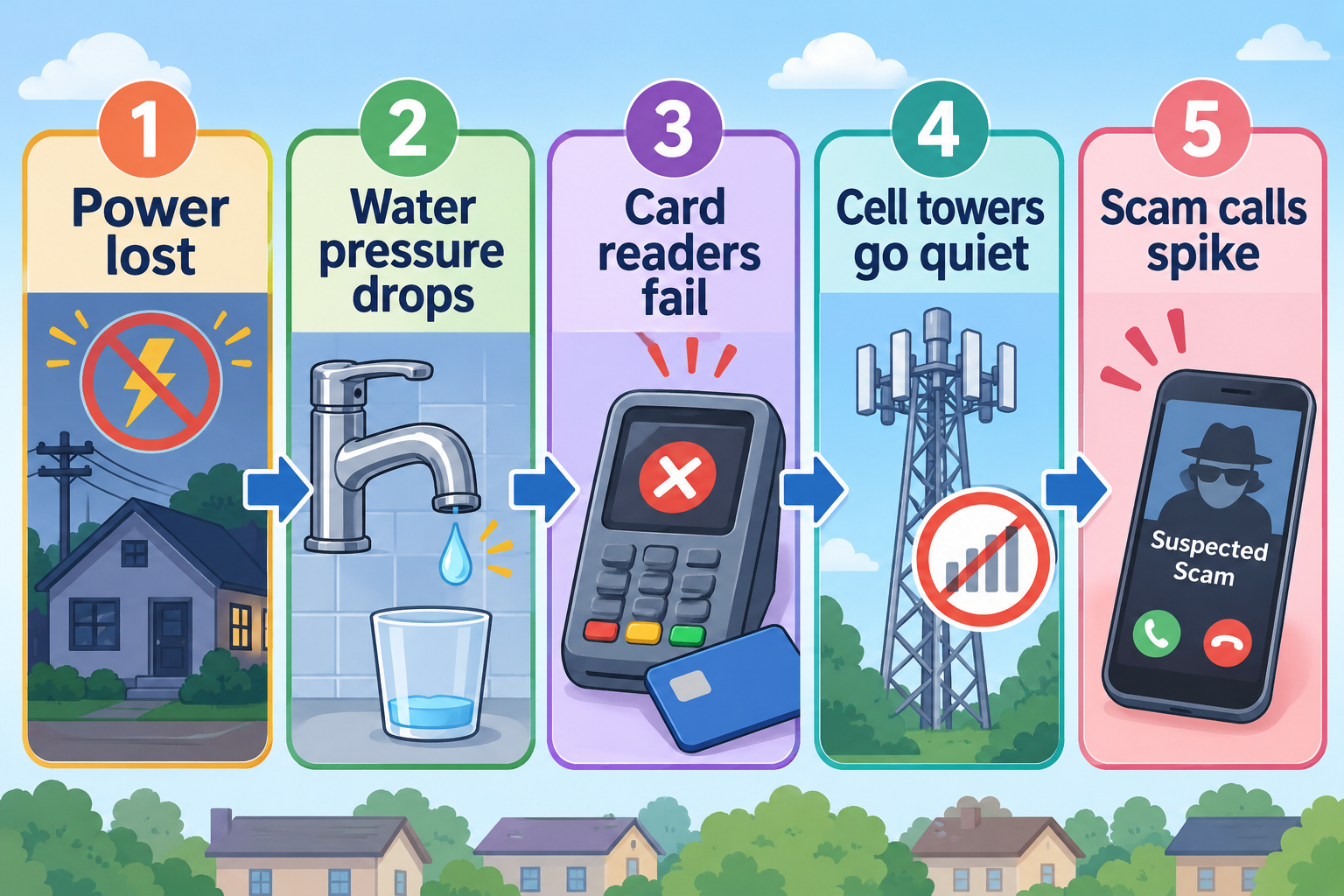
- Cash: small bills stored securely, since card readers often fail without power
- Manual tools: a way to manually open your garage door, and basic tools to shut off gas or water if needed
Choose a portable power station over a gas generator if you live in an apartment, need quiet indoor-safe power for medical devices, or want to avoid carbon monoxide risk entirely.
Common Mistakes People Make Preparing for System Outages
The biggest mistake is treating preparedness as an all-or-nothing project instead of a handful of small, repeatable habits. People either do nothing, or they buy a mountain of gear once and never rotate, check, or practice with it.
Other frequent errors:
- Storing water and never rotating it. Replace stored water every six months.
- Keeping cash but never updating the amount. Inflation and changing needs mean last year’s stash may not cover a week anymore.
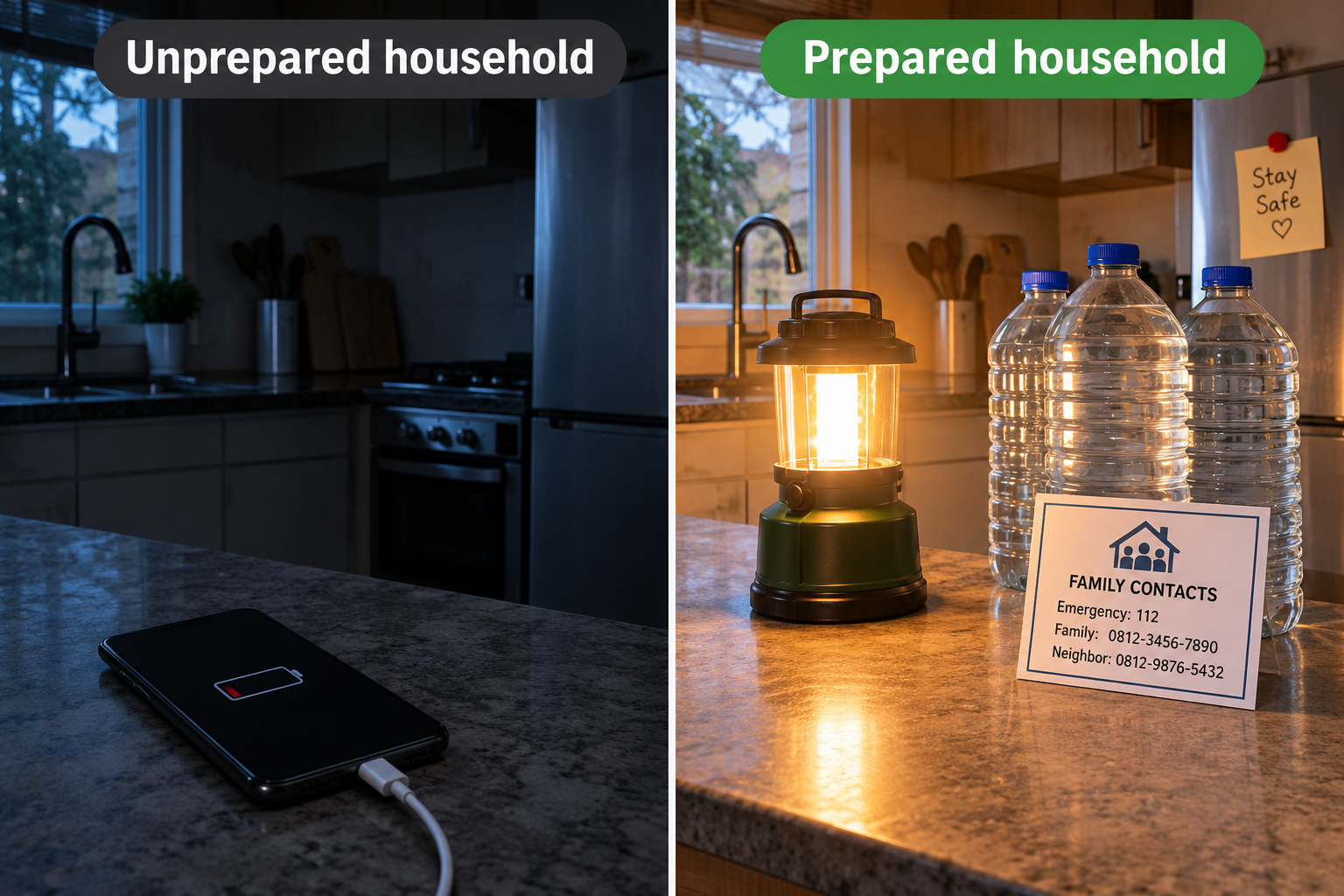
- Relying only on phone contacts. If your phone dies, a mental list of numbers isn’t a backup.
- Running a generator in a garage or near windows. This remains a leading cause of carbon monoxide deaths after storms.
- Assuming kids’ schools will just “figure it out.” Confirm pickup authorization and emergency contacts are current, not just assumed.
- Forgetting pets. Water, food, and a leash belong in every kit, not as an afterthought.
- Never practicing the plan. A family contact plan nobody has tested usually falls apart the first time it’s actually needed.
Can You Still Order Delivery or Get Packages in a Ground Stop?
Ground deliveries from services like Amazon, UPS, and FedEx ground shipping usually continue normally during an FAA ground stop, since they don’t rely on air transport for most shipments. Only air-shipped or “overnight air” packages see direct delays.
Food delivery apps like DoorDash or Uber Eats are unaffected by a ground stop itself, but they will be affected by a power outage, since restaurants, payment processors, and delivery drivers all need functioning systems to operate. If you’re worried about a disruption spreading beyond aviation, the safer assumption is: ground delivery holds up fine during a ground stop, but falls apart fast during a power or network outage.
What’s the Impact on Hospitals and Emergency Services During a Ground Stop?
Hospitals can see delays in air-shipped organ transplants, specialized lab samples, and medevac flights during an FAA ground stop, though routine 911 and ambulance services on the ground are not directly affected. The bigger risk to emergency services comes from power or network outages, not air travel disruptions.
During the November 2026 event specifically, there were no widely reported disruptions to emergency medical air transport once the stop lifted after roughly four hours. But hospitals that depend on time-sensitive air shipments (organs for transplant, specific lab testing, blood products) build in buffer time precisely because ground stops, weather delays, and cargo backlogs happen often enough to plan around.
Decision rule: if you or a family member depends on a scheduled medical shipment (dialysis supplies, specialty medication, a transplant), ask your provider now what their contingency plan is for air transport disruptions. Don’t wait until a ground stop is already underway.
Your 7-Day Cyber-Disruption Action Plan
- Day 1: Store water (one gallon per person per day, aim for two weeks) and find your home’s shutoff valve.
- Day 2: Build a pantry with food you’ll actually eat, plus a manual can opener.
- Day 3: Get lanterns, headlamps, batteries, and a charged power bank for every family member.
- Day 4: Withdraw small-bill cash and start a paper “life binder” with key documents and numbers.
- Day 5: Pick an out-of-area contact, two meeting places, and get a battery or crank radio.
- Day 6: Turn on multi-factor authentication everywhere, set a family code word, and freeze your credit.
- Day 7: Run a 15-minute family drill, then plan your next upgrade: a bigger pantry, a generator, or a first aid class.

Frequently Asked Questions
Was the November 13, 2026 FAA ground stop caused by a cyberattack?
No. Officials said it stemmed from a telecommunications failure that overloaded aging routers across 22 air traffic control centers, with no indication of a cyberattack.
How long should my household be prepared to go without power or services?
Plan for at least two weeks of water, food, and basic supplies, not the old 72-hour minimum. Three days should feel easy; two weeks should feel manageable.
How much water should I store?
Store at least one gallon per person per day for drinking and sanitation, with extra for pets, hot weather, and anyone pregnant, nursing, or ill.
How much cash should I keep at home?
Enough small bills to cover a few days to a week of essentials like food, fuel, and medicine, stored in a fire-resistant safe or bag.
Can AI really make attacks on infrastructure easier?
Yes. Security researchers at Dragos documented attackers in 2026 using commercial AI tools to help target a Mexican water utility, warning that AI compresses expert-level attack planning into hours.
What’s the most common scam during an outage?
Impersonation scams, including fake airline rebooking agents, fake utility shutoff calls, and fake bank fraud alerts. Never act on an incoming message; contact the company yourself using a trusted number.
Does a ground stop mean my flight is cancelled?
Not usually. Most ground-stop flights are delayed, not cancelled. Check your airline’s app before assuming the worst.
Will my packages still arrive during a ground stop?
Ground shipments typically continue normally. Only air-shipped or overnight-air packages see delays tied directly to the ground stop.
Conclusion
The November 13, 2026 ground stop wasn’t a disaster story. It was a stress test, and the system passed: planes landed safely, the stop lifted, and airlines worked through the backlog. But it’s also a preview of what happens when overloaded, aging infrastructure meets modern demand, whether that’s air traffic control, your local power grid, or the payment processor running your grocery store’s card readers.
You don’t need a bunker. You need water, food, light, cash, paper copies of what matters, a radio, a family plan that works without a cell signal, and a healthy skepticism toward anyone who calls you with an urgent problem. Start with Day 1 this weekend. Build it out over a week. Then you’re not scared of the next outage, cyber or otherwise. You’re just ready.