

Nearly 180,000 American households now live completely off the electrical grid, and that number has doubled since 2020. Off-grid living means generating your own power, managing water independently, and handling waste without municipal services—creating complete self-sufficiency on your property. What started as a fringe lifestyle has evolved into a mainstream housing option driven by energy costs, climate resilience, and personal independence.
Key Takeaways
- Complete energy independence requires 2,000-3,000 watts of solar capacity plus battery storage for most households
- Initial setup costs range from $15,000 for basic systems to $150,000+ for luxury off-grid homes
- Water management involves collection, storage, filtration, and greywater recycling systems
- Legal considerations vary dramatically by state and county—some areas restrict or prohibit off-grid living
- Essential skills include basic electrical work, plumbing, water testing, and equipment maintenance
- Hidden challenges include social isolation, medical access, internet connectivity, and higher food costs
- Long-term savings depend on your location’s utility costs and system maintenance expenses
What Exactly Is Off-Grid Living and How Do People Actually Do It
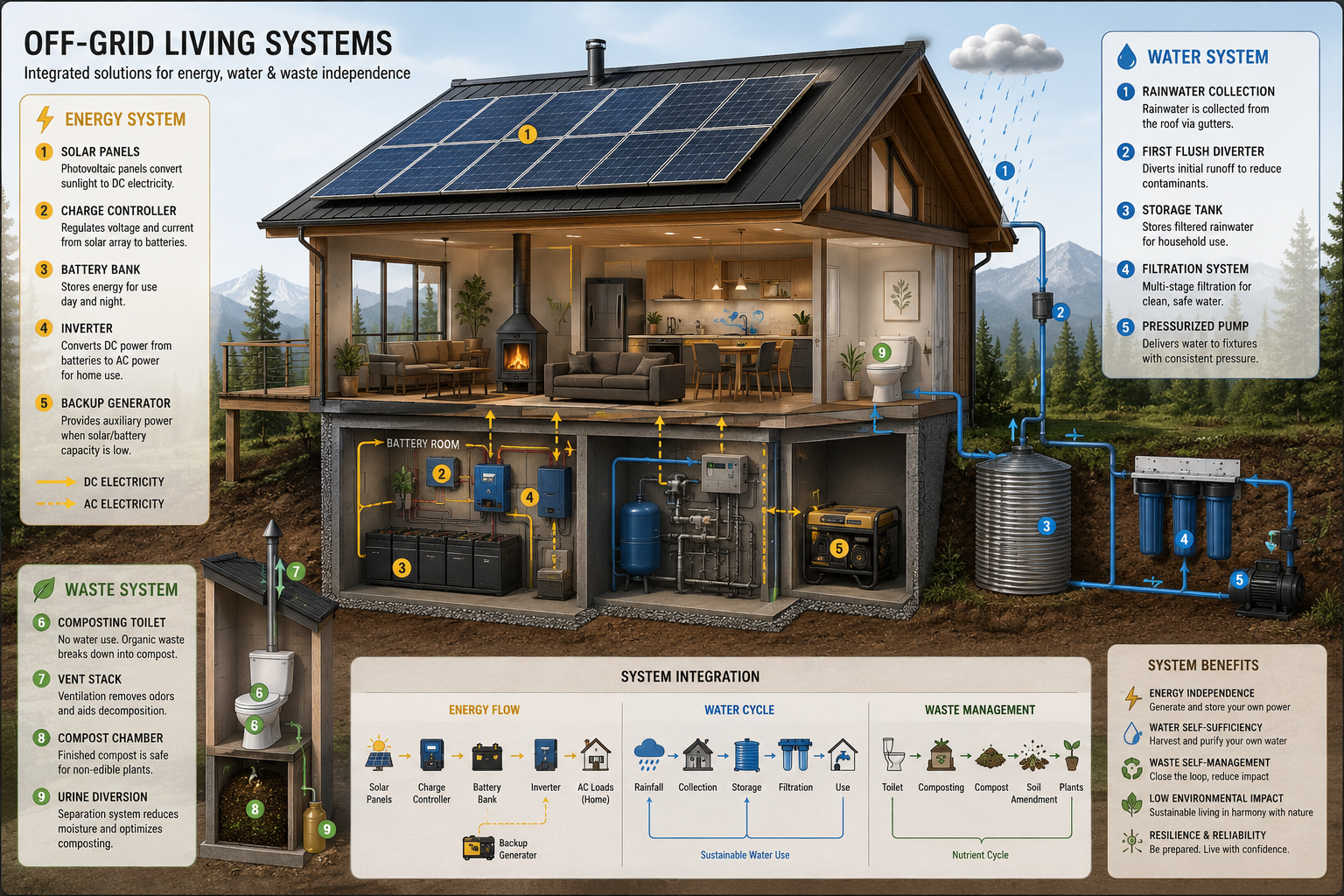
Off-grid living means your home operates independently from public utilities—no electrical grid connection, municipal water, sewer systems, or natural gas lines. You generate electricity through solar panels, wind turbines, or micro-hydro systems, collect rainwater or drill wells, and manage waste through septic systems or composting toilets.
Most off-grid homes start with a power system foundation: solar panels (typically 2,000-3,000 watts), battery banks for energy storage, charge controllers, and inverters to convert DC power to household AC. You’ll add backup generators for extended cloudy periods and high-demand situations.
Water independence requires multiple components: collection systems (roof catchment, wells), storage tanks, filtration systems, and greywater recycling. Many off-grid residents use composting toilets to eliminate blackwater entirely.
The key difference from “grid-tied with backup” systems is that off-grid homes must be completely self-sufficient. You can’t draw power from utility lines when your batteries run low or your solar production drops.
How Much Does It Cost to Set Up an Off-Grid Home From Scratch
Basic off-grid systems start around $15,000-25,000 for a small cabin, while comprehensive setups for full-sized homes range from $50,000-150,000 or more. Your biggest expenses are the electrical system (40-50% of total costs), water infrastructure (20-30%), and waste management (10-15%).
Electrical system breakdown:
- Solar panels: $3,000-8,000 (depending on wattage)
- Battery bank: $8,000-20,000 (lithium systems cost more but last longer)
- Inverters and controllers: $2,000-4,000
- Installation and wiring: $3,000-6,000
Water and waste systems:
- Well drilling: $3,000-15,000 (varies by depth and location)
- Water storage and filtration: $2,000-8,000
- Septic or composting systems: $3,000-12,000
Choose basic systems if you’re starting with a small cabin or testing off-grid living. Invest in premium components if you’re building a permanent family home—the upfront cost difference pays off through reliability and longevity.
Best Solar Panel Systems for Remote Cabin Living
Monocrystalline solar panels offer the best efficiency for limited roof space, producing 300-400 watts per panel compared to 250-300 watts for polycrystalline options. For remote cabins, prioritize panels rated for extreme weather conditions and those with 25-year warranties from established manufacturers.
Top system configurations for cabins:
- Small cabin (under 800 sq ft): 2,000-watt solar array with 10-15 kWh battery storage
- Medium cabin (800-1,500 sq ft): 3,000-4,000 watts with 20-30 kWh storage
- Large cabin (1,500+ sq ft): 5,000+ watts with 40+ kWh storage
Pair your panels with MPPT charge controllers rather than PWM controllers—they’re 20-30% more efficient at converting solar power to stored battery energy. Install panels at your latitude angle plus 15 degrees for optimal year-round production.
Common mistake: Undersizing your battery bank. You need enough storage for 3-4 days without sun, not just overnight power. Calculate your daily energy use, multiply by four, then add 20% safety margin.
Off-Grid Living Challenges No One Talks About
Social isolation hits harder than most people expect, especially during winter months when travel becomes difficult and daylight hours shrink. Many off-grid residents underestimate how much they’ll miss casual social interactions, reliable internet for video calls, and easy access to entertainment or dining options.
Hidden operational challenges:
- Equipment failures always happen at the worst times (during storms, holidays, or when stores are closed)
- Propane delivery becomes expensive and logistically complex in remote areas
- Food costs increase 20-40% due to bulk buying requirements and limited fresh options
- Medical emergencies require detailed evacuation plans and longer response times
Maintenance reality: You’ll spend 5-10 hours per month on system maintenance—cleaning solar panels, testing water quality, monitoring battery health, and troubleshooting equipment issues. This isn’t a “set it and forget it” lifestyle.
The biggest surprise for most families is how much mental energy goes into resource management. You constantly monitor power levels, water usage, weather forecasts, and supply levels in ways that grid-connected homes never require.
Can You Really Save Money by Living Off the Grid Long Term
Long-term savings depend entirely on your local utility costs and how much you spend on off-grid infrastructure. If you’re replacing $200+ monthly utility bills, most systems pay for themselves within 8-12 years. But if your current utilities cost under $150 monthly, the financial case becomes much weaker.
Break-even analysis factors:
- Initial system cost vs. monthly utility savings
- Maintenance and replacement costs (batteries need replacement every 10-15 years)
- Property value changes (some areas see increases, others decreases)
- Hidden costs like propane, equipment repairs, and higher insurance
Where off-grid saves money: Remote properties where utility connection costs $20,000-50,000, areas with expensive electricity (over $0.20/kWh), and properties used seasonally where you’d pay connection fees year-round.
Where it doesn’t: Suburban areas with cheap electricity, places requiring expensive water solutions (deep wells, water delivery), or locations with poor solar resources requiring oversized systems.
Choose off-grid for energy independence and lifestyle reasons first. Treat any financial savings as a bonus rather than the primary motivation.
Off-Grid Living for Beginners – What Skills Do I Need
Start with basic electrical knowledge—understanding volts, amps, watts, and how to safely work with 12V DC systems. You don’t need electrician-level expertise, but you must be comfortable reading multimeters, connecting wires, and troubleshooting simple electrical problems.
Essential skill priorities:
- Basic electrical work: Installing outlets, running wire, understanding circuit protection
- Plumbing basics: Connecting pipes, installing fixtures, understanding water pressure
- Equipment maintenance: Following manufacturer schedules, recognizing warning signs
- Water testing: Using test kits, understanding contamination risks
Skills you can learn as needed: Solar panel installation (hire professionals initially), well drilling (always hire professionals), septic system maintenance (annual professional service recommended).
Most successful off-grid beginners start by camping on their property for extended periods, gradually building systems and skills. This approach lets you identify your actual needs rather than guessing from theoretical calculations.
Common beginner mistake: Trying to replicate your current lifestyle exactly. Off-grid living requires some behavioral changes—shifting high-energy activities to sunny days, being more conscious of water usage, and planning around weather patterns.
Is Off-Grid Living Legal in My State
Off-grid living legality varies dramatically by state and local jurisdiction. Some states actively support off-grid development, while others have building codes that effectively prohibit it. The biggest legal hurdles typically involve septic systems, well permits, and minimum dwelling size requirements.
Most off-grid friendly states: Montana, Idaho, Wyoming, Alaska, New Hampshire, and rural areas of Texas. These states generally have fewer restrictions and more supportive local governments.
States with significant restrictions: California (strict building codes), New York (septic regulations), Florida (hurricane building requirements), and most densely populated East Coast areas.
Key legal research steps:
- Check county building codes for minimum dwelling sizes
- Research septic system requirements and permits
- Verify well drilling regulations and water rights
- Understand electrical system inspection requirements
Critical point: Even in off-grid-friendly states, individual counties or townships may have restrictive ordinances. Always research local regulations before purchasing property or beginning construction.
Some areas require grid connection even if you don’t use it, while others prohibit certain waste management systems. Hire a local attorney familiar with property law if you’re investing significant money.
Cheapest Places to Live Off Grid in the US
Rural areas of Montana, Idaho, Wyoming, and northern Maine offer the lowest land costs combined with off-grid-friendly regulations. You can find buildable parcels for $1,000-3,000 per acre, compared to $10,000+ per acre in popular off-grid destinations like Colorado or North Carolina.
Top budget-friendly regions:
- Eastern Montana: $1,500-2,500/acre, minimal building restrictions, good solar resources
- Northern Idaho: $2,000-4,000/acre, abundant water, supportive communities
- Rural Wyoming: $1,200-2,800/acre, excellent solar and wind resources
- Northern Maine: $1,500-3,500/acre, good water access, established off-grid culture
Hidden cost considerations: Remote properties often require expensive well drilling, longer utility runs for backup services, and higher transportation costs for materials and supplies.
Avoid these “cheap” traps: Desert areas with no water access, flood-prone regions requiring expensive foundations, and areas with restrictive HOAs or municipal codes that weren’t disclosed upfront.
Research property taxes, which vary enormously even within states. Some rural counties have very low tax rates, while others fund services through higher property assessments.
How Do Families with Kids Manage Off-Grid Lifestyle
Families with children need larger, more reliable systems and backup plans for everything. Your power system should be oversized by 50% compared to adult-only households, and you’ll need redundant systems for critical functions like refrigeration and heating.
Kid-specific considerations:
- Reliable internet for schoolwork (consider Starlink satellite internet)
- Larger battery banks for consistent power during homework hours
- Backup heating systems for safety during equipment failures
- Emergency communication systems for medical situations
Education options: Many off-grid families homeschool or use online school programs. Rural areas may offer school bus service even to remote properties, but verify this before buying land.
Social development: Plan regular trips to town for activities, sports, and social interaction. Some off-grid families join community centers or churches specifically to maintain social connections for their children.
Safety planning: Develop detailed emergency protocols, maintain first aid supplies, and ensure multiple communication methods. Consider proximity to medical facilities when choosing property locations.
Most successful off-grid families start when children are young (under 10) or wait until they’re adults. The teenage years present unique challenges with social needs and technology expectations.
Water Collection and Filtration Systems for Remote Properties
Rainwater collection provides the most reliable water source for most off-grid properties, requiring about 1,000 square feet of roof area to collect enough water for a family of four in areas with 30+ inches annual rainfall. Combine this with well water or spring sources for redundancy.
Complete water system components:
- Collection: Gutters, downspouts, first-flush diverters, storage tanks
- Storage: Food-grade tanks (minimum 1,000 gallons, preferably 2,500+ gallons)
- Filtration: Sediment filters, carbon filters, UV sterilization
- Distribution: Pressure tanks, pumps, plumbing to fixtures
Water quality testing: Test your water source quarterly for bacteria, annually for chemical contaminants. Well water often contains minerals that require specific filtration approaches, while rainwater may need pH adjustment.
Greywater systems: Route washing machine and sink water to irrigation systems or constructed wetlands. This reduces your freshwater needs by 40-60% and helps with waste management.
Winter considerations: Insulate pipes and tanks, install heat tape in freezing climates, and maintain backup water supplies during equipment maintenance periods.
Off-Grid Power Options Besides Solar
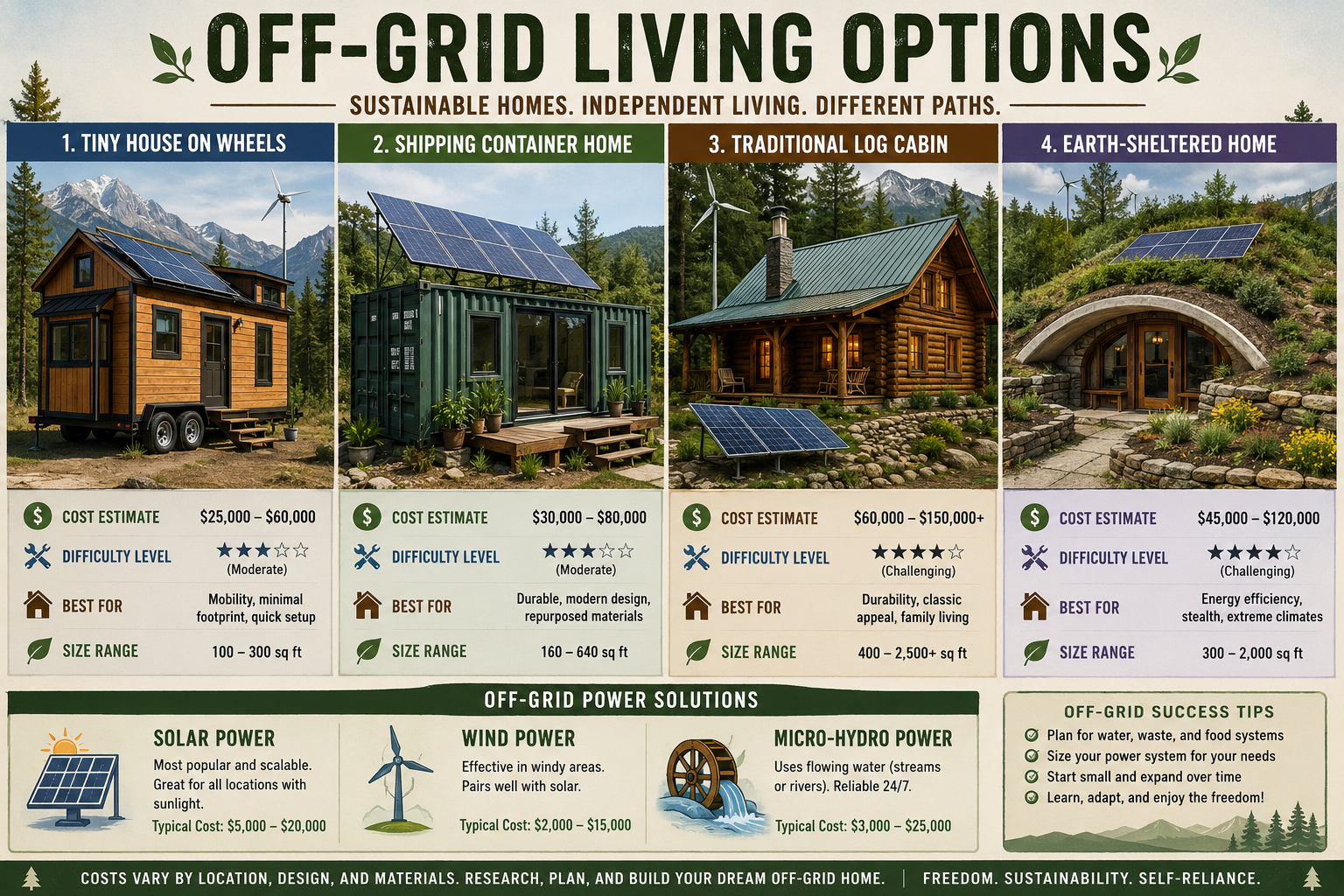
Micro-wind turbines work well in consistently windy areas (average 10+ mph winds), but they require more maintenance than solar panels and can be noisy. Small residential wind systems produce 400-1,000 watts in good conditions, making them excellent supplements to solar rather than primary power sources.
Alternative power options:
- Micro-hydro: Most reliable option if you have flowing water; can produce power 24/7
- Wind turbines: Good for windy locations; pair with solar for balanced production
- Generators: Propane, diesel, or gasoline backup systems for extended low-production periods
Hybrid system benefits: Combining solar with wind or micro-hydro reduces battery storage requirements and provides power during different weather conditions. Solar dominates during summer, while wind often peaks during winter storms.
Generator sizing: Choose generators that produce 2-3 times your average hourly consumption to quickly recharge batteries and handle high-demand periods. Propane generators offer the best fuel storage characteristics for backup use.
Maintenance reality: Wind systems require annual inspections and bearing replacements every 3-5 years. Micro-hydro systems need seasonal cleaning and intake maintenance. Generators need monthly exercise runs and annual service.
What Medical Considerations Matter for Remote Living
Remote living requires comprehensive medical planning, especially for anyone with chronic conditions or regular medication needs. Your nearest hospital may be 45+ minutes away, and emergency services might have limited access to your property during certain weather conditions.
Essential medical preparations:
- Medication supplies: Maintain 90-day supplies of all prescriptions
- First aid training: Wilderness first aid certification recommended for all adults
- Communication systems: Satellite communicators for emergency contact
- Medical equipment: Blood pressure monitors, thermometers, pulse oximeters for chronic conditions
Evacuation planning: Maintain vehicle access year-round, identify helicopter landing areas for severe emergencies, and register with local emergency services so they can find your property quickly.
Telemedicine setup: Reliable internet enables remote consultations for non-emergency issues. Many off-grid residents use satellite internet specifically for medical access and prescription management.
Preventive care scheduling: Plan medical appointments, dental cleanings, and routine screenings during town trips. Many off-grid residents batch medical appointments to minimize travel.
Consider proximity to medical facilities when choosing property. An extra 30 minutes to the hospital might not matter for routine needs but could be critical during emergencies.
Common Mistakes People Make When First Going Off Grid
The biggest mistake is underestimating power consumption and overestimating system production. Most people calculate their energy needs based on utility bills, but off-grid systems must handle peak loads and extended low-production periods that grid-tied homes never experience.
Critical planning mistakes:
- Undersized battery banks: You need 3-4 days of storage, not just overnight power
- Inadequate backup power: Generators should produce 2-3x your average consumption
- Poor load management: High-energy appliances need scheduling around power production
- Insufficient maintenance planning: Budget 5-10% of system cost annually for upkeep
Location mistakes: Buying property without verifying water access, solar exposure, or legal building requirements. Always test wells, measure solar potential, and research local codes before purchasing.
Lifestyle adjustment failures: Trying to maintain exactly the same energy usage patterns as grid-connected living. Successful off-grid living requires some behavioral changes and energy consciousness.
Equipment quality shortcuts: Buying cheap batteries or inverters that fail within 2-3 years instead of quality components that last 10-15 years. The upfront savings disappear quickly through replacement costs and system downtime.
Start with a smaller, simpler system and expand gradually. This approach lets you learn your actual needs and develop maintenance skills before investing in complex, expensive systems.
FAQ
How much land do I need for off-grid living?
Most off-grid homes work well on 1-5 acres, providing space for solar arrays, water storage, septic systems, and gardens. Larger properties offer more privacy and resource options but aren’t necessary for basic off-grid functionality.
Can I get internet in off-grid locations?
Yes, through satellite internet services like Starlink, which provide high-speed internet virtually anywhere. Cellular boosters can also improve phone-based internet in areas with weak signal coverage.
What happens when my solar batteries die?
Lithium batteries typically last 10-15 years, while lead-acid batteries need replacement every 5-8 years. Plan for battery replacement costs in your long-term budget—usually $8,000-15,000 for a complete battery bank replacement.
Do I need permits for off-grid systems?
Most areas require permits for electrical systems, septic installations, and well drilling. Solar installations often need electrical permits and inspections, even for off-grid systems. Check with your local building department.
How do I handle garbage and recycling off-grid?
Most off-grid residents haul garbage to transfer stations or arrange private pickup service. Composting reduces organic waste significantly, and burning non-recyclable paper products is legal in many rural areas.
Can I live off-grid in winter?
Yes, but winter requires larger battery banks, backup heating systems, and careful energy management. Solar production drops significantly in northern climates, making backup generators essential during extended cloudy periods.
What about home insurance for off-grid properties?
Many standard insurers cover off-grid homes, but you may need specialized rural or farm insurance policies. Some insurers offer discounts for solar systems and fire-resistant construction materials.
How do I maintain my off-grid systems?
Follow manufacturer maintenance schedules for all equipment, test water quality regularly, clean solar panels seasonally, and inspect electrical connections annually. Most maintenance tasks are straightforward but require consistency.
Can I sell an off-grid property easily?
Off-grid properties appeal to specific buyers, potentially limiting your market but often commanding premium prices among interested buyers. Properties with well-designed, maintained systems typically sell faster than those needing system upgrades.
What’s the learning curve for off-grid living?
Most people need 6-12 months to become comfortable with system management and energy consciousness. The first year involves frequent adjustments and learning experiences, but systems become routine with experience.
Do off-grid homes increase in value?
Property values depend on local market conditions and system quality. Well-designed off-grid systems often increase property values, especially in areas with expensive utility connections or frequent power outages.
How do I finance off-grid construction?
Construction loans for off-grid homes can be challenging since many lenders require utility connections. Consider owner financing, cash purchases, or specialized rural construction lenders familiar with off-grid projects.
Conclusion
Off-grid living in 2026 represents a viable lifestyle choice supported by mature solar technology, reliable battery systems, and growing community resources. Success requires realistic planning, adequate financial investment, and willingness to adapt your lifestyle around natural energy cycles and resource management.
Start your off-grid journey by visiting existing off-grid communities, attending renewable energy workshops, and consulting with system designers in your target area. Consider beginning with a small cabin or seasonal property to develop skills before committing to full-time off-grid living.
The key to successful off-grid living lies in thorough preparation, quality equipment, and realistic expectations about both the challenges and rewards of energy independence.
SEO Meta Title: Comprehensive Off-Grid Living Master Guide 2026 | Complete Setup